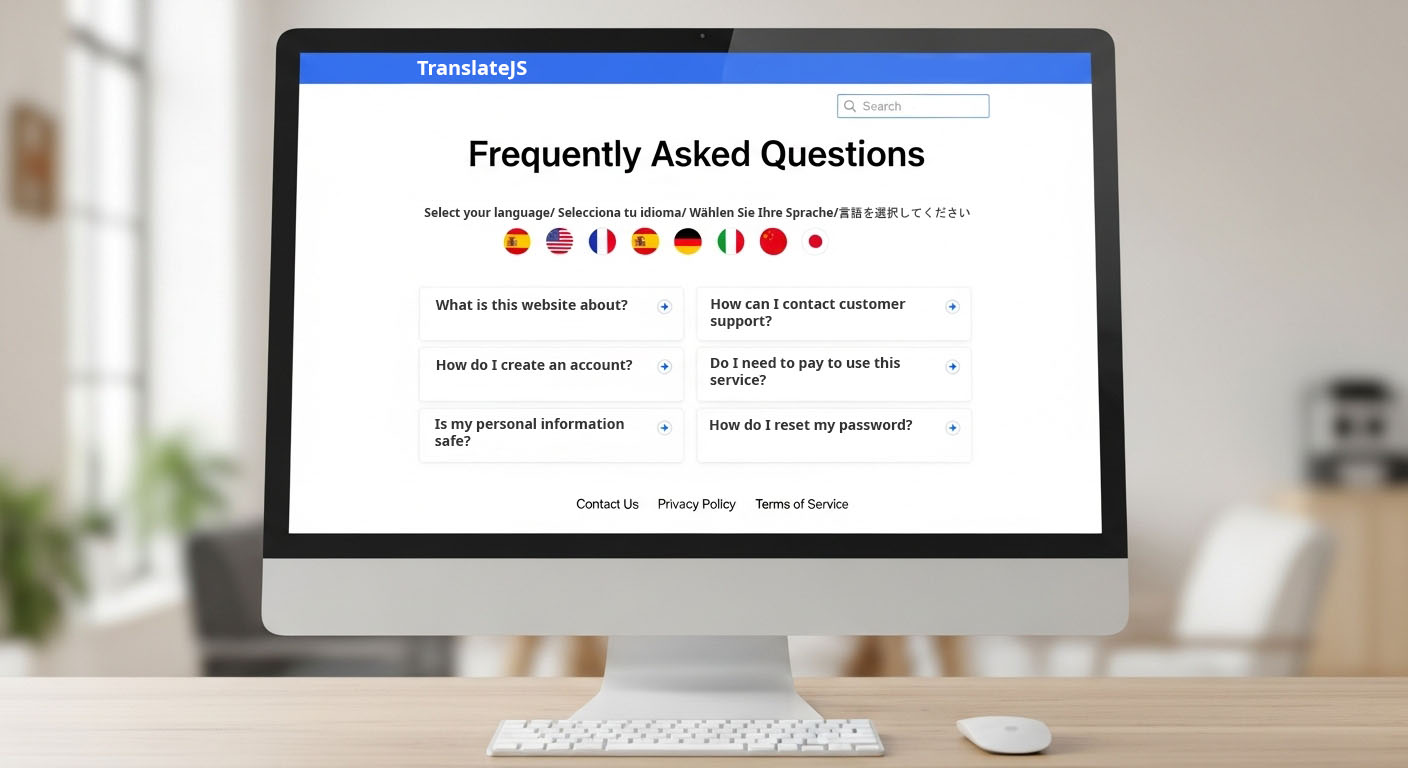
Your customer service inbox is probably overflowing right now. Support tickets pile up faster than your team can respond, response times stretch from hours to days, and customers get increasingly frustrated. You keep hiring more support staff, but the problem never seems to get better.
What if I told you that a significant portion of those tickets should not exist at all?
The reality is that many support requests come from customers who simply could not find answers in their own language. They resort to opening tickets for basic questions that are already answered in your FAQ section. The problem is not that the information does not exist. Its that the information exists only in a language they dont fully understand.
The language barrier nobody talks about
Here is what most companies dont realize: when you only provide support content in English, you are creating an invisible barrier that forces non-English speakers to contact support even for the simplest issues.
The numbers tell a stark story:
- 70% of customers are more loyalto companies that provide support in their native language
- 29% of businesses have lost customersspecifically because they could not provide language support
- 84% of customers abandon a purchasedue to poor customer service related to language barriers
- 42% of consumers never buyfrom sites when information is not available in their own language
Think about what this means for your support team. If nearly half of your potential customers cannot understand your self-service content, they have only two choices: contact support or leave. And the ones who do contact support end up creating tickets that would never exist if your FAQs were simply available in their language.
The real cost of language barriers in customer support
Let me walk through what actually happens when your support content is not translated.
Increased ticket volume for basic questions
When customers cannot understand your FAQ section, they submit tickets for questions you have already answered dozens of times:
- “How do I reset my password?”
- “What is your return policy?”
- “How long does shipping take?”
- “Do you ship to my country?”

These are not complex technical issues. These are simple informational questions that should be answered through self-service. But without translated content, each one becomes a support ticket that requires a human response.
If your support team handles 1,000 tickets per month and even 20% of those are basic FAQ questions from non-English speakers, that is 200 tickets that should not exist. At an average handling time of 10 minutes per ticket, you are wasting over 33 hours of support time every month on completely preventable questions.
Longer resolution times
Even when customers do speak some English, language barriers slow everything down. Support agents need to:
- Read broken English or use translation tools to understand the issue
- Craft responses in simple English that the customer can understand
- Go back and forth multiple times to clarify misunderstandings
- Escalate to managers when communication breaks down completely
What should be a 5-minute ticket turns into a 20-minute ordeal. Your average resolution time increases, your customers get frustrated, and your support team burns out faster.
Higher support costs
Hiring multilingual support agents seems like the obvious solution, but it comes with serious challenges:
- 85% of support managersfind it difficult to hire qualified multilingual representatives
- Multilingual support departments have turnover rates of45-50%(compared to 30-40% for standard support roles)
- Multilingual agents often command higher salaries due to their specialized skills
You end up paying more for agents who are harder to find and harder to keep. And even when you do build a multilingual team, you need enough coverage for each language during all support hours. The costs add up quickly.
Frustrated customers who leave
Perhaps the biggest cost is the customers you lose entirely. Almost 40% of customers feel frustrated when they cannot communicate with customer service in their preferred language. Many do not even bother opening a ticket because they assume they will not be understood.
They just leave. They buy from your competitor who offers support in their language. And you never even know they existed.
How translated FAQs cut support tickets by 30% or more
Now here is the good news: translating your self-service content can dramatically reduce support ticket volume while simultaneously improving customer satisfaction.
When customers can read FAQs, knowledge base articles, and troubleshooting guides in their native language, several things happen:
Self-service rates skyrocket
Studies consistently show that over 56% of consumers consider accessing information in their own language more important than price. When you translate your FAQs and support content:
- Customers actually read your documentation instead of skipping it
- They find answers faster because they understand the content
- They feel confident following instructions without fear of misunderstanding
- They successfully solve problems on their own
Companies that implement comprehensive multilingual FAQs typically see self-service rates increase by 25-40%. That translates directly into fewer support tickets.
Ticket quality improves
The tickets you do receive become more substantive. Instead of basic “how do I” questions, your team handles:
- Legitimate bugs and technical issues
- Feature requests and feedback
- Complex problems that truly require expert assistance
Your support team stops wasting time on repetitive basic questions and focuses on high-value interactions that actually improve your product and customer experience.
Response times decrease
With fewer tickets to handle, your support team can respond faster to the tickets that do come in. Your average response time might drop from 24 hours to 6 hours. First response time becomes a competitive advantage instead of a source of frustration.
Customer satisfaction increases
When customers can help themselves in their native language, they feel empowered rather than dependent. They get answers instantly instead of waiting hours or days for a support response. And when they do need to contact support, they receive faster, better service because your team is not overwhelmed.
This creates a virtuous cycle: fewer tickets → faster responses → happier customers → better reviews → more sales.
Beyond FAQs: other support content that needs translation
While FAQs are the obvious starting point, other types of support content benefit massively from translation:
Knowledge base articles
Your detailed how-to guides, best practices, and troubleshooting documentation should all be available in multiple languages. These long-form resources often contain the solutions to complex problems. When customers can read them in their native language, they can solve advanced issues without contacting support.
Product documentation
User manuals, setup guides, and feature explanations reduce support burden when customers can understand them. This is especially important for technical products or software where proper setup prevents problems down the road.
Error messages and notifications
Nothing frustrates customers more than cryptic error messages they cannot understand. Translating error messages and notifications helps customers fix problems immediately instead of opening support tickets to ask “what does this mean?”
Video tutorials and help content
If you create video tutorials, adding subtitles or voiceovers in multiple languages extends their usefulness to a global audience. Visual content combined with native language explanation is extremely effective for self-service.
The traditional approach is expensive and slow
So why do not more companies translate their support content? Because traditional translation methods are painful:
- Export all your contentfrom your knowledge base or CMS
- Send it to translatorsand wait days or weeks for translations
- Review and editthe translations for accuracy
- Manually importthe translated content back into your system
- Set up language-specific pagesor subdomains to serve the content
- Maintain synchronizationbetween languages when you update content
This process is expensive, time-consuming, and creates ongoing maintenance headaches. Every time you update an FAQ or add a new article, you need to go through the entire process again for each language.
Most companies look at this workflow and decide it is not worth the effort. They accept the increased support burden instead of dealing with the complexity of translation.
The automated solution: instant multilingual support content
What if you could translate all your support content in seconds instead of weeks?
Modern automated translation tools make this possible. Instead of complex workflows, you add one line of code to your website and your entire knowledge base becomes instantly available in dozens of languages.
Here is what this looks like in practice:
- Add the translation scriptto your knowledge base or support site (one line of code, takes 5 minutes)
- Choose your target languagesfrom a simple dashboard
- Customize the language switcherto match your brand
- Done
Every FAQ, every article, every piece of support content is now automatically translated. Customers select their preferred language and see everything in that language. When you update an article, the translations update automatically.
Key benefits of automated translation
- No waiting: Content is translated instantly, not in days or weeks
- No coordination: No back-and-forth with translation agencies
- No maintenance: Updates happen automatically when you change content
- Editable translations: You can review and edit any translation to ensure quality
- SEO optimized: Proper hreflang tags, meta descriptions, and canonical tags are automatically implemented
- Cost effective: Monthly subscription instead of per-word translation fees
Real impact on support teams
Companies that implement automated translation for their support content typically see:
- 25-40% reductionin support ticket volume within the first month
- 15-30% improvementin customer satisfaction scores
- Significant decreasein average resolution time
- Lower support costsas fewer multilingual agents are needed for basic tier-1 support
Your existing support team becomes more effective because they handle fewer repetitive questions and focus on complex issues that truly need human expertise.
Start with your top 5 FAQs
You do not need to translate everything at once. Start small and measure the impact:
- Identify your 5 most common support questions
- Make sure you have good FAQ answers for them
- Translate those FAQs into your top 2-3 customer languages
- Track how many tickets you receive for those questions over the next month
You will probably see a noticeable drop in tickets related to those topics. This proves the concept and justifies expanding translation to your entire knowledge base.
If you use our automated translation script, this entire experiment takes few seconds to set up.
The bottom line
Every support ticket costs you money in agent time, tools, and opportunity cost. When customers cannot find answers in their own language, they generate preventable tickets that waste your team’s time and frustrate everyone involved.
Translating your FAQs and support content is not just about being “customer friendly.” It is a direct cost reduction strategy that makes your support operation more efficient while simultaneously improving customer satisfaction.
The old excuse that translation is too expensive and complex no longer holds up. Automated solutions make multilingual support content accessible to any business, regardless of size or technical resources.
The question is not whether you should translate your support content. The question is how much money you are willing to keep wasting on preventable support tickets.
Make your website multilingual
Break language barriers and connect with audiences worldwide. Expand your reach, grow your business, and go global today.
No credit card required