
Most business owners think entering a new market means a big announcement. A press release. A paid ad campaign. A LinkedIn post about “exciting new horizons.” And that approach works sometimes. But it also immediately tells every local competitor that someone new is coming for their customers.
There’s a smarter way to enter a new market quietly — build presence, attract customers, and start generating revenue before anyone local even knows you exist. This post is about exactly that.
Why making noise when entering a new market is a mistake
When a foreign business enters a local market loudly, local competitors have time to react. They can drop their prices. They can run their own campaigns to lock in customer loyalty before you arrive. They can contact their existing clients and remind them why they should stay local. They have the home advantage — they know the language, the culture, the payment preferences, and they already have trust.
If you give them warning, you give them time. And time is the one thing you don’t want to give a competitor who is already established where you’re trying to go.
The quiet launch is about removing that warning. You show up in the market gradually, through organic search, through word of mouth, through the natural discovery process. By the time local competitors notice you, you already have customers. And customers are much harder to take back than prospects.
Step 1: Get found before you announce yourself
The first foothold in any new market is search visibility. People in your target country are already searching for what you sell right now, today. They’re typing queries into Google in their own language. If your website exists only in English, you are completely invisible to them — not because you’re not good enough, but because you’re not there.
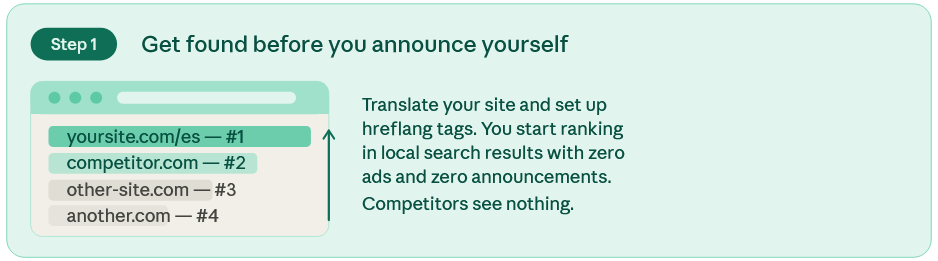
This is where a translated website becomes your quiet entry tool. When you translate your website into Spanish, French, Portuguese, Polish, or any other language, and implement proper hreflang tags so Google indexes those language versions correctly, you start appearing in local search results. You’re not running ads. You’re not issuing a press release. You’re just… there. Ranking. Quietly.
A local competitor who isn’t tracking Google Search Console for keyword movements in their own country probably won’t even notice a foreign website climbing in the rankings until you’re already established. Organic search is slow and invisible compared to a paid ad blitz — and that’s exactly what makes it powerful for a quiet launch.
Step 2: Match the market before you meet it
Before you invest in a full local marketing campaign, translated organic presence lets you test whether the market actually wants what you sell. You translate the website, you watch the traffic, and you see which pages attract visitors from the target country, which products get clicks, and what search terms bring people in.
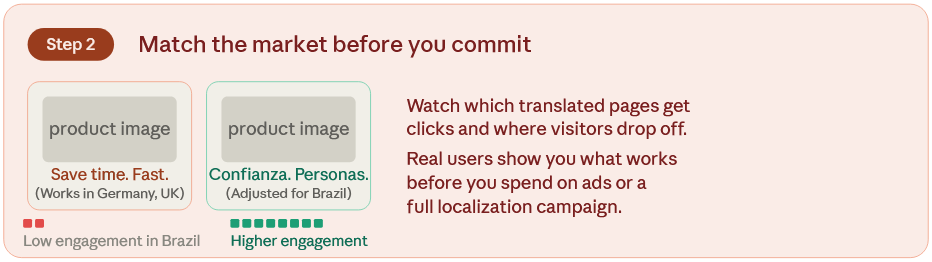
This is real market research without a consultant, without focus groups, and without a budget. You’re getting actual signal from actual people in the target market who found you through actual searches.
This matters because markets differ more than people expect.
A software tool that sells itself on “saving time” works well in countries where time is considered money — the US, UK, Germany, Scandinavia. In markets where relationships and trust are the primary buying factor — much of Latin America, Southern Europe, the Middle East — a website that leads with efficiency and speed but says nothing about reliability or human support will underperform, even if the product is excellent.
A home decor product that sells well in minimalist markets like Japan, Denmark, or the Netherlands might need completely different positioning in markets that prefer ornate, colorful, or traditional aesthetics — like Morocco, India, or Brazil.
When your website is translated and live, you see which pages people actually engage with. You see where they drop off. You learn the market cheaply, before you commit to expensive localization of your advertising or your physical presence.
Step 3: Use the language itself as a trust signal
One of the most underestimated advantages of a translated website is what it signals to the visitor. It tells them: this company thought about me. They took the time to speak my language. That is not a small thing.
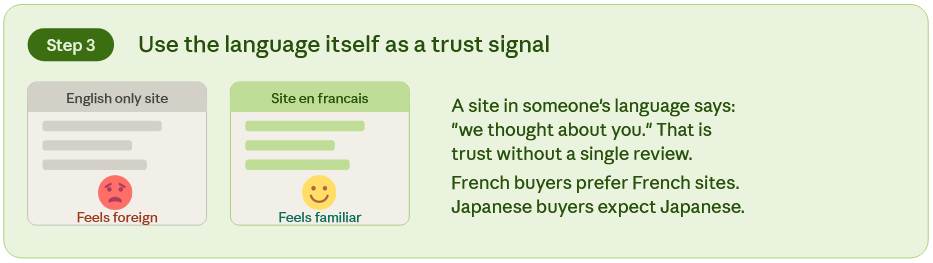
Trust is hard to build from scratch in a new market. You have no reviews, no local press, no word of mouth yet. But a website in someone’s native language immediately removes one of the biggest barriers: the sense that this is a foreign company that doesn’t really understand the local customer.
In France, this matters enormously. French consumers are well-documented in their preference for French-language commerce — studies have consistently shown that French buyers are significantly less likely to complete a purchase on a foreign-language website compared to buyers in, say, the Netherlands. Showing up in French is not just a nice touch; it’s a requirement for serious conversion in that market.
In Japan, the expectation of Japanese-language content for any company that wants to be taken seriously is even stronger. A website that exists only in English signals to Japanese buyers that the company doesn’t really serve them — even if the product ships internationally and would work perfectly well for them.
In Brazil, where the internet population is enormous and growing fast, Portuguese-language content is the difference between being discovered and being ignored.
Step 4: Let people spread the news for you
A quiet launch doesn’t mean a slow launch. It means a launch where the noise comes from customers, not from you.
When someone in Mexico finds your product through a Google search, has a great experience, and tells three friends — those three friends are warm leads coming to your already-translated website. They arrive, they read in Spanish, they trust what they see because their friend recommended it. They buy. They tell more people.
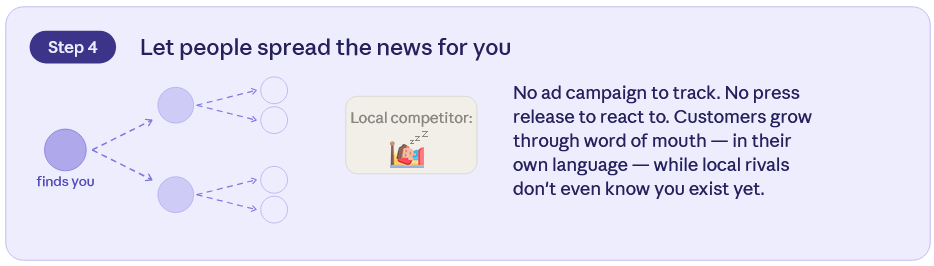
This kind of growth is invisible to competitors for a long time. There’s no campaign to track. There’s no ad spend to notice. There’s no press release to react to. It just grows, quietly, while local competitors are focused on the customers they already have and the competitors they already know about.
By the time a local competitor notices you — maybe they see your domain appearing in search results, maybe a customer mentions you — you already have social proof, reviews, and a customer base in their market. At that point, competing against you is much harder than it would have been if they’d spotted you six months earlier.
What markets make the most sense for a quiet entry right now
Not every market is equally suitable for a quiet digital entry. Here are some where organic search visibility in the local language can give you a real, sustained advantage:
Polandhas a large, well-educated population with high internet penetration and strong demand for software tools, e-commerce, and professional services. English proficiency is moderate, which means local-language content is a significant differentiator. Polish SaaS and e-commerce competitors are active but often focused locally, making it easier for a foreign company to rank for terms they haven’t thought to target.
Brazilis the largest internet market in Latin America, with over 170 million internet users. Competition from international companies is surprisingly thin in many product categories, partly because many foreign businesses underestimate the market and partly because Portuguese-language content is sparse from non-Brazilian companies. A well-translated website with good content can rank faster here than in more saturated English-speaking markets.
The Netherlandshas extremely high internet penetration and e-commerce adoption, very high English proficiency (which is both a help and a challenge), and a strong preference for transparent, informative purchasing decisions. Dutch-language content signals seriousness and investment in the local market.
Mexicois one of the fastest-growing e-commerce markets in the world. The middle class is expanding, digital payment infrastructure is improving rapidly, and consumers are increasingly comfortable buying from international brands — if those brands communicate in Spanish and address local payment and shipping expectations.
Romania and Czech Republicare smaller markets but have growing tech-savvy middle classes, relatively low competition from international companies in many product categories, and populations that respond well to local-language content even though English proficiency is reasonable.
The common mistakes that blow your cover
Translation can go wrong in a few specific ways.
Translating only the homepage.If someone arrives on your homepage in their language and then clicks to a product page that’s entirely in English, the trust you built disappears instantly. The translation has to cover the full buying journey — landing pages, product pages, checkout, and error messages.
Ignoring technical SEO for the translated pages.A translated website that isn’t properly set up with hreflang tags, translated meta titles, and translated meta descriptions won’t rank the way it should. Google needs to understand that these are language-specific versions of your content, not duplicate pages. Without correct hreflang implementation, you can actually hurt your rankings instead of helping them.
Launching all markets at once.If you try to enter 20 countries simultaneously, you spread your attention too thin. Pick one or two markets where the opportunity is clearest, do those well, and expand from there.
Setting up translation and walking away.Translated content should be monitored and improved. Automatic translations are a strong starting point, but some product-specific terms, brand voice elements, or technical phrases will need manual editing to read naturally. The ability to edit translations is important — set it and forget it is not the right approach.
How to actually do this without a developer and a budget
The practical question is: how do you get a translated, properly SEO-configured website live without spending months on development or tens of thousands on professional translation?
TranslateJSis built exactly for this. You add one line of code to your website, choose which languages you want to target, and the tool handles translation automatically across all your pages. The language switcher design is customizable, and you can set colors to match your existing brand so it looks like part of the original site rather than an add-on.
On the SEO side, it automatically handles hreflang tags, translated meta titles, meta descriptions, and canonical tags — the technical pieces that most DIY translation attempts get wrong and that determine whether Google actually indexes your translated pages correctly.
If your website runs on WordPress, there’s aTranslateJS pluginthat handles setup without touching code at all.
And when the automatic translation needs adjustment — a product name that doesn’t translate well, a phrase that reads awkwardly in Portuguese, a local expression that would work better than the literal version — you can edit any translation manually, directly, without rebuilding anything.
The quiet launch used to require a local agency, a localization team, and months of work. The technical barrier is much lower now. The strategy is the same, but the execution is faster and more accessible than it’s ever been.
Make your website multilingual
Break language barriers and connect with audiences worldwide. Expand your reach, grow your business, and go global today.
No credit card required