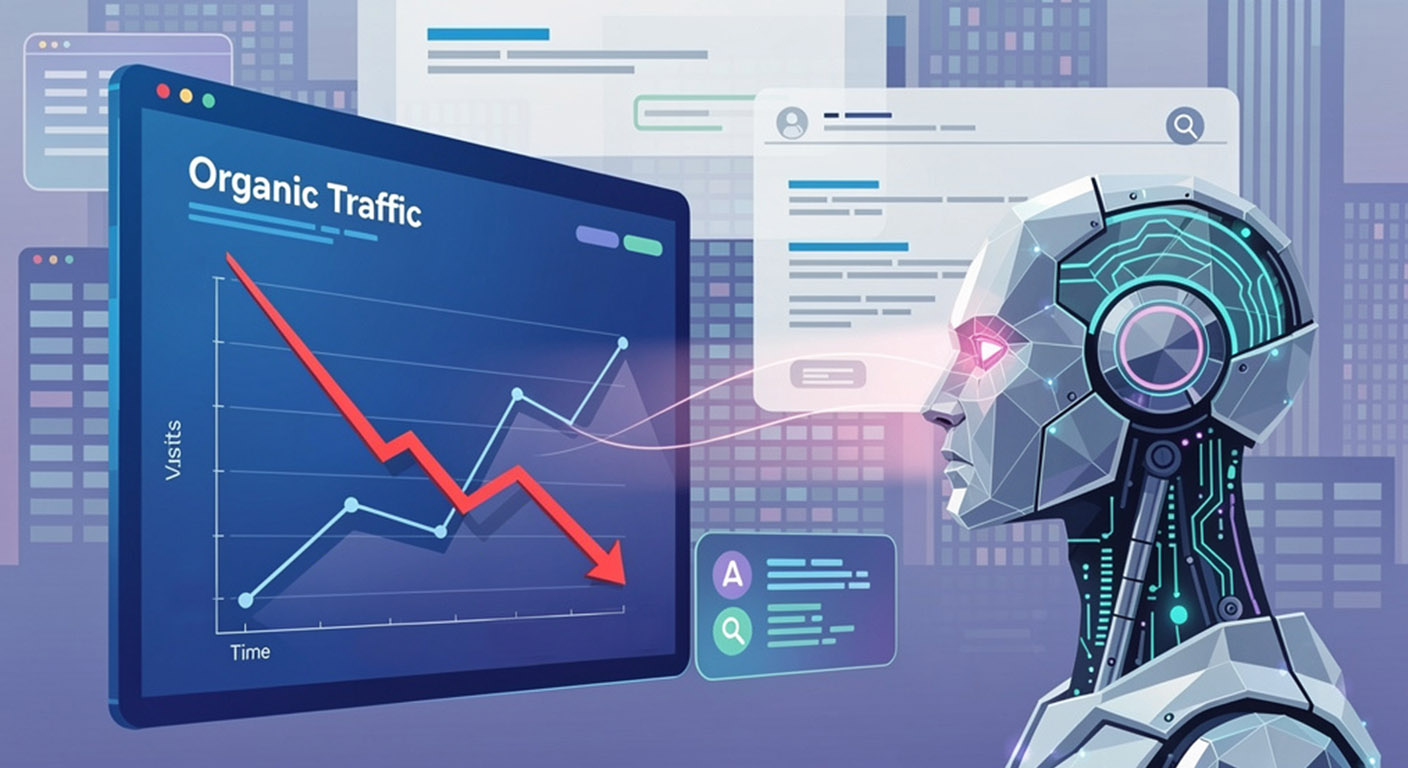
Organic search traffic is dropping. Here is what the data actually says
If your website traffic has been falling since mid 2024 and you can not figure out why, you are not alone. Rankings look the same. Impressions in Search Console are holding. But clicks are down, sessions are down, and leads are quieter than they used to be.
This is not your imagination. It is not a problem with your website specifically. It is a structural shift in how people use the internet to find information — and the data behind it is clear enough that it’s worth understanding in detail before you decide what to do next.
What is actually happening to organic search traffic
The short version: Google is answering more questions directly on its own search results page, which means fewer people click through to websites.
At the same time, a growing number of users are skipping Google entirely and asking ChatGPT, Perplexity, Gemini, or other AI tools instead.
Both of these trends eat into the traffic that used to come to your website through organic search.
Zero-click searches hit a new record
Zero-click is a type of search where the user gets the answer directly on the search engine results page and does not click any website link.
For example, user searches: “Weather in New York”.
The answer appears immediately on Google, so the user leaves without visiting another site. That is a zero-click search.
Zero-click searches rose from 56% to 69% between May 2024 and May 2025 — a 13 percentage point increase in a single year. That means more than two out of three Google searches now end without anyone clicking on a single result. The user got an answer from the AI summary at the top and left.
In Google’s AI Mode, the zero-click rate climbs to 93%. When someone uses Google’s AI Mode — the conversational search interface — they visit an actual website less than 1 time in 10.
Click-through rates collapsed for informational content
Organic click-through rates for informational queries featuring Google AI Overviews fell 61% since mid-2024, while paid CTRs on those same queries dropped 68%, according to a study by Seer Interactive that analyzed 3,119 queries across 42 organizations, covering 25.1 million organic impressions from June 2024 to September 2025.
To put that in plain terms: organic CTR dropped from 1.76% to 0.61% for queries with AI Overviews, while paid CTR crashed from 19.7% to 6.34%. Both organic and paid traffic are getting hit — this is not just an SEO problem.
Pew Research tracked 68,000 real searches from 900 US adults and found users clicked a result only 8% of the time when an AI summary appeared, compared to 15% without one — a 46.7% relative click reduction on every query Google decides to answer with an AI Overview.
Even queries without AI Overviews are losing clicks
This is the part most people miss. Even queries without AI Overviews saw organic CTRs fall 41% year-over-year. The behavioral shift is happening everywhere, not just on the queries where an AI box appears. Users have simply learned to expect answers on the page, and they click less overall.
AI Overviews are spreading fast
AI Overviews appeared on 6.49% of queries in January 2025, doubled to 13.14% by March, and reached 30% of US desktop queries by September 2025, according to Semrush. The rollout is ongoing and accelerating. Categories that were previously safe — commercial, transactional, local — are increasingly seeing AI summaries appear above organic results.
Real companies, real traffic losses
Looking at individual company data makes the scale of the problem more concrete.
HubSpot‘s organic traffic fell from 13.5 million visits in November 2024 to approximately 6 to 7 million by early 2025 — a loss of nearly half their monthly organic sessions in a matter of weeks. HubSpot is one of the most well-resourced content marketing operations in the world. They have hundreds of writers, a dedicated SEO team, and years of domain authority built up. It didn’t protect them.
Healthlinelost approximately 50% of organic traffic. CNN lost between 27% and 38%. Major tech publications collectively lost 58% of their Google traffic since 2024, with some individual sites seeing drops up to 85%.
Business Insiderlost 55% of organic traffic between 2022 and 2025, and cut 21% of its staff as a consequence.
The median publisher experienced a 10% year-over-year traffic decline in the first half of 2025, with news publishers down 7% and non-news content sites down 14%.
These are not small blogs with weak content. These are organizations with editorial teams, strong backlink profiles, and established domain authority. The losses are happening at the structural level, not the content quality level.
Why informational content is hit hardest
Not all traffic is affected equally. The pattern that keeps appearing in every study is the same: informational queries — those seeking definitions, explanations, and how-to answers — saw 30–40% organic traffic declines as zero-click AI responses mean users never scroll to organic results.
This makes sense when you think about how AI Overviews work. Google’s AI is very good at answering questions like “what is X”, “how does Y work”, “best way to do Z”. It pulls from existing web content, summarizes it, puts the answer at the top, and the user never needs to scroll. The website that originally created that content gets no visit.
For educational platforms and how-to content, this creates an existential challenge. When users search “how to change a tire” or “what are the symptoms of diabetes”, AI Overviews now provide step-by-step instructions directly on the search page, effectively turning publisher investments into training data for Google’s AI with no reciprocal traffic benefit.
Commercial and transactional queries are less affected — for now. A person searching “buy running shoes size 10 Berlin” or “book hairdresser appointment London” still needs to visit a website to complete the action. AI can not book an appointment for them or take their payment. This distinction matters a lot for what we discuss at the end of this post.
The traffic did not disappear — it moved
One important thing the data shows: people are not asking fewer questions. They are asking questions in different places. AI platforms generated 1.13 billion referral visits in June 2025, a 357% increase from June 2024. AI-sourced sessions surged 527% year-over-year in the first half of 2025.
Traffic is moving from Google to AI chat interfaces. Users who would previously have Googled something are now asking ChatGPT or Gemini. The total volume of questions being asked is probably higher than ever. But the answers are being given by AI, not by your website.
There is a consistent pattern across many sites: more rankings but less traffic. Organic listings show up more often in search results than before, but they earn fewer clicks. Impressions stay flat or grow. Clicks drop. This is the new normal.
Which industries are most exposed
The degree of exposure depends heavily on what kind of content a website publishes and what its visitors are trying to do.
High exposure:blogs, news sites, how-to content, recipe sites, health information sites, financial explainer sites, educational content, product review sites, definition pages. Anything where the user’s goal is to get an answer — and AI can give that answer without a click.
Lower exposure:e-commerce, local services, booking platforms, SaaS product pages, job boards, real estate listings, anything where the user needs to take an action that requires visiting the site. A person searching for a plumber in Lisbon still needs to click somewhere. A person searching for what causes pipe corrosion might now get the answer from an AI box.
73% of B2B websites saw significant traffic losses between 2024 and 2025, averaging a 34% year-over-year decline. B2B tech queries now trigger AI Overviews 70% of the time.
What website owners are actually doing about it
The honest answer is that there is no single fix. The shift is structural, and the strategies that worked for organic search for the past fifteen years need updating.
Promoting services through social networks.
Social platforms are no longer just branding channels. For many businesses, they have become direct acquisition channels that generate leads, bookings, and recurring customers without depending entirely on Google traffic.
Choosing the right platform for the business model. Not every social network works equally well for every industry. The strongest results usually come from matching the platform format to the customer buying behavior.
Instagramworks best for visual and lifestyle-driven businesses. Restaurants, gyms, beauty salons, fashion brands, dentists, tattoo studios, photographers, interior designers, and luxury services perform well because customers want visual proof before buying. Short-form Reels, before-and-after content, and local influencer collaborations tend to generate the highest engagement.
TikTokfavors businesses that can educate or entertain quickly. Contractors, car detailers, real estate agents, mechanics, fitness coaches, and small local businesses often grow rapidly by posting short videos explaining problems, showing transformations, or documenting real work. Authentic content usually performs better than polished advertising.
LinkedInis the strongest platform for B2B and professional services. SaaS companies, agencies, consultants, lawyers, accountants, recruiters, and enterprise service providers benefit from publishing industry insights, case studies, and thought leadership content. Decision-makers are far more active there than on entertainment-focused platforms.
Facebookstill performs well for local service businesses. Home improvement companies, cleaning services, local restaurants, medical clinics, auto repair shops, and community-based businesses benefit from local groups, marketplace exposure, reviews, and geographically targeted advertising.
YouTubeis highly effective for high-trust purchases. Financial advisors, software companies, healthcare providers, educators, and technical service businesses gain long-term visibility because YouTube content ranks in both Google and YouTube search results. Detailed tutorials and educational videos continue generating traffic for years.
Pinterestworks particularly well for search-driven visual industries. Wedding planners, home decor brands, architects, DIY creators, recipe websites, and ecommerce stores often receive long-term referral traffic because Pinterest behaves more like a visual search engine than a traditional social network.
Building platform-native content. Businesses that repost identical content everywhere usually underperform. Each platform rewards different behaviors, formats, and audience expectations. Vertical short videos dominate TikTok and Instagram Reels, while LinkedIn rewards expertise and commentary. Matching the content style to the platform algorithm improves visibility significantly.
Using social proof as conversion leverage. Reviews, customer testimonials, user-generated content, and client transformations increase trust faster than traditional advertisements. Businesses showing real customers and real outcomes generally outperform businesses focused only on polished branding.
Creating repeat visibility. Most buyers do not convert after one interaction. Consistent posting keeps the business visible during the customer consideration cycle. A user who ignores five posts may convert after the sixth once the need becomes immediate.
Combining social content with retargeting ads. Organic content creates awareness, while retargeting campaigns convert warm audiences later. Businesses that combine both typically reduce customer acquisition costs because users already recognize the brand before seeing the advertisement.
Building audience ownership outside platforms. Social networks should feed owned channels such as email lists, SMS lists, private communities, or customer databases. Algorithms change constantly, but direct audience ownership protects businesses from sudden reach declines.
Using short-form video as the primary growth format. Nearly every major platform now prioritizes short video distribution. Businesses publishing educational, entertaining, or behind-the-scenes videos consistently receive more reach than static image posts alone.
Leveraging local discovery algorithms. Platforms increasingly recommend nearby businesses based on engagement, location tags, reviews, and local relevance. Consistent geographic tagging and locally relevant content help businesses appear more often in regional discovery feeds.
Treating social media as a search engine. Younger audiences increasingly search directly on TikTok, Instagram, and YouTube instead of Google. Optimizing captions, video titles, hashtags, and spoken keywords improves discoverability inside social platform search results.
Prioritizing consistency over production quality. Businesses often delay posting because they focus too heavily on professional production. In practice, consistent authentic content usually outperforms infrequent polished campaigns. Algorithms reward posting frequency and audience retention more than cinematic quality.
More approaches that appear most consistently in recent industry research:
Getting cited inside AI Overviews.Brands cited in AI Overviews earn 35% more organic clicks than those that aren’t cited. Being referenced as a source inside the AI summary means you still get traffic — sometimes more than the traditional organic listing would have delivered. This requires high-authority, well-structured content that AI systems trust enough to cite.
Focusing on transactional and commercial intent.Content that ends with a user taking an action on your website — booking, buying, signing up — is far less vulnerable than informational content. AI can answer a question but it can not complete a transaction on your behalf.
Building direct traffic channels.Email lists, newsletters, communities, and social channels that do not depend on Google become more valuable as Google-driven traffic becomes less reliable.
Diversifying into multiple languages.This is the strategy most website owners overlook completely, and it is one of the most practical responses to the current situation.
Why website translation is one of the smartest responses to the AI traffic drop
Here is something the data does not yet fully capture: AI Overviews are primarily an English-language phenomenon right now.
By Q1 2026, AI Overviews appear in approximately 13% of all search queries globally — but this global figure masks significant variation. The feature is most aggressively deployed in English-language search results. In Spanish, Portuguese, German, Polish, Japanese, or Arabic search results, AI Overviews are far less prevalent. Organic search in those languages still works more like Google worked in 2022 — results appear, people click, traffic flows.
This means a website that exists only in English is competing in the most AI-disrupted search environment on the internet. The same website translated into Spanish, Portuguese, or Polish enters search markets where organic click-through rates are significantly higher, AI competition is lower, and a translated page that ranks well actually delivers real clicks.
There is a second effect that works in your favor. A foreign-language visitor who lands on your website because you rank in their language search is doing exactly the kind of transactional or commercial search that AI Overviews currently do not intercept well. They want to buy something, book something, or sign up for something. These are the visitors most likely to convert — and least likely to have been satisfied by an AI answer at the top of the page.
A translated website also unlocks entirely new keyword territory. Your English pages compete against thousands of other English websites for every ranking position. A Spanish or Polish version of those same pages competes against a much smaller pool of competitors, many of whom have not optimized seriously for those languages.
Translate.jsis a practical way to act on this. You add one line of code to your website, choose which languages to target, and the tool handles translation across all your pages automatically. The SEO side — hreflang tags, translated meta titles, meta descriptions, and canonical tags — is handled automatically, so Google indexes the language versions correctly and routes the right users to the right page. For WordPress sites, there is a published plugin that sets this up without code.
The translations are editable, so you can adjust any wording that does not read naturally or that uses terminology specific to your industry in ways that auto-translation gets wrong.
The core insight is this: when your primary source of traffic is being disrupted, the smartest response is not just to optimize harder for the channel that is shrinking. It is to open channels that are still healthy. Non-English organic search is one of those channels, and it is available to most websites right now with less technical effort than it used to require.
The bottom line
Search is not dead. People are not asking fewer questions. But the mechanism that used to turn those questions into website visits is changing fast, and the data from 2024 and 2025 makes clear that this is a permanent shift, not a temporary dip.
The businesses that will come out of this in the best position are those that stopped treating organic English search as their only growth channel and started building presence in places where the rules have not changed yet. Multilingual search is one of those places. It is real, it is measurable, and the barrier to entry is lower than most people think.
Make your website multilingual
Break language barriers and connect with audiences worldwide. Expand your reach, grow your business, and go global today.
No credit card required