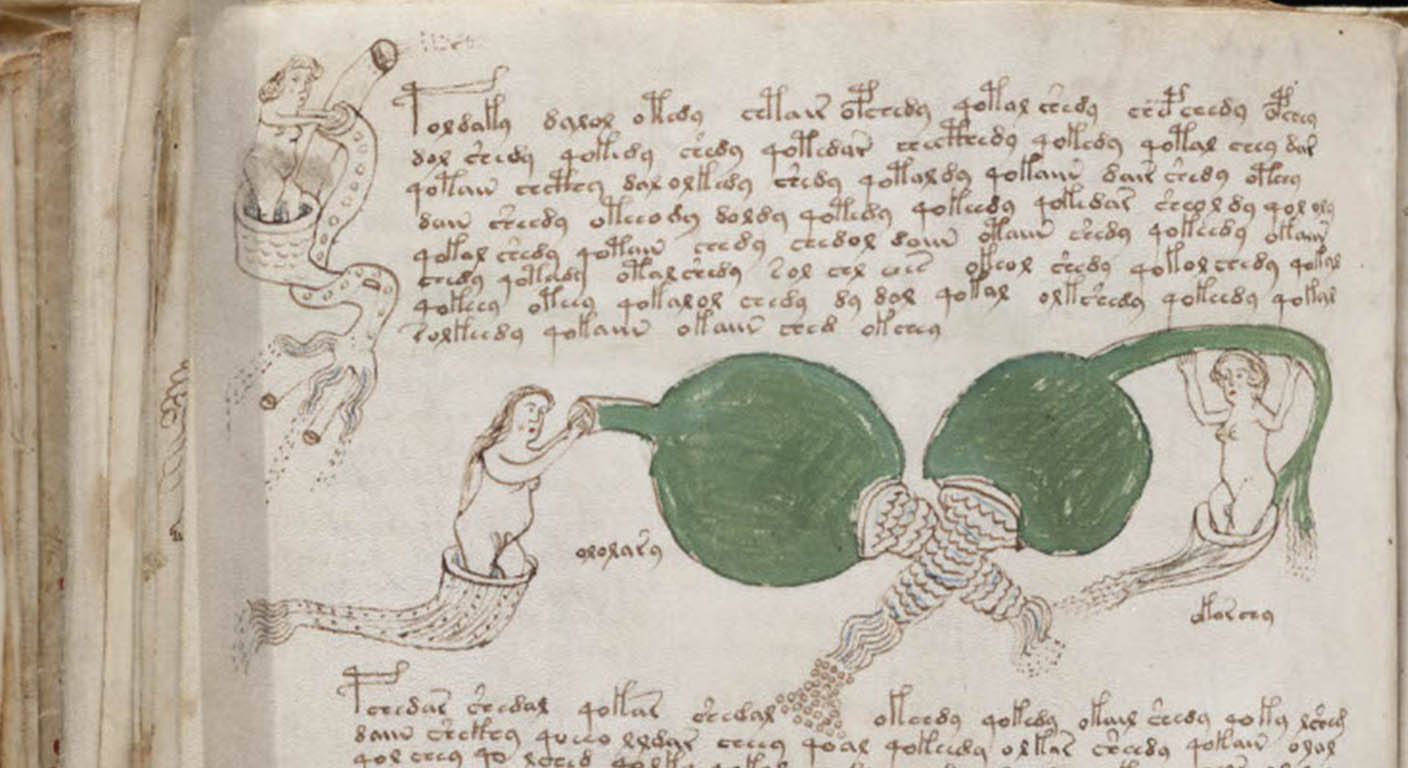
The Voynich manuscript is widely considered the most mysterious document in the history of the world. It is a fully illustrated, handwritten codex that dates back to the early 15th century. But unlike any other medieval book, it is written entirely in an unkown language and an unknown writing system. Despite the best efforts of the greatest cryptographers, linguists, and computer scientists, not a single word of this book has ever been translated.
Physical description and materials
If you were to hold the manuscript in your hands, you would find it is relatively small. The pages measure about 23.5 by 16.2 centimeters, and the book is about five centimeters thick. There are currently around 240 vellum pages remaining, but historical evidence suggests that some pages were lost long before the book was even rediscovered in the modern era. The text is written from left to right, and the right margin is quite uneven, which is typical for handwritten texts of that period.
Researchers have tested the vellum pages using carbon-14 dating. The results showed with high confidence that the animal skin used to make the pages dates somewhere between 1404 and 1438. The ink used for the writing is a standard iron gall ink, which was very common in europe during the renaissance. Interestingly, the colorful paint applied to the strange drawings was likely added much later, perhaps by a different owner who wanted to make the book look more expensive or interesting.
The bizarre contents and sections
The book is almost entirely illustrated, which is the only reason researchers have been able to divide it into distinct sections. Each section presents a different kind of subject matter, though none of it makes logical sense.
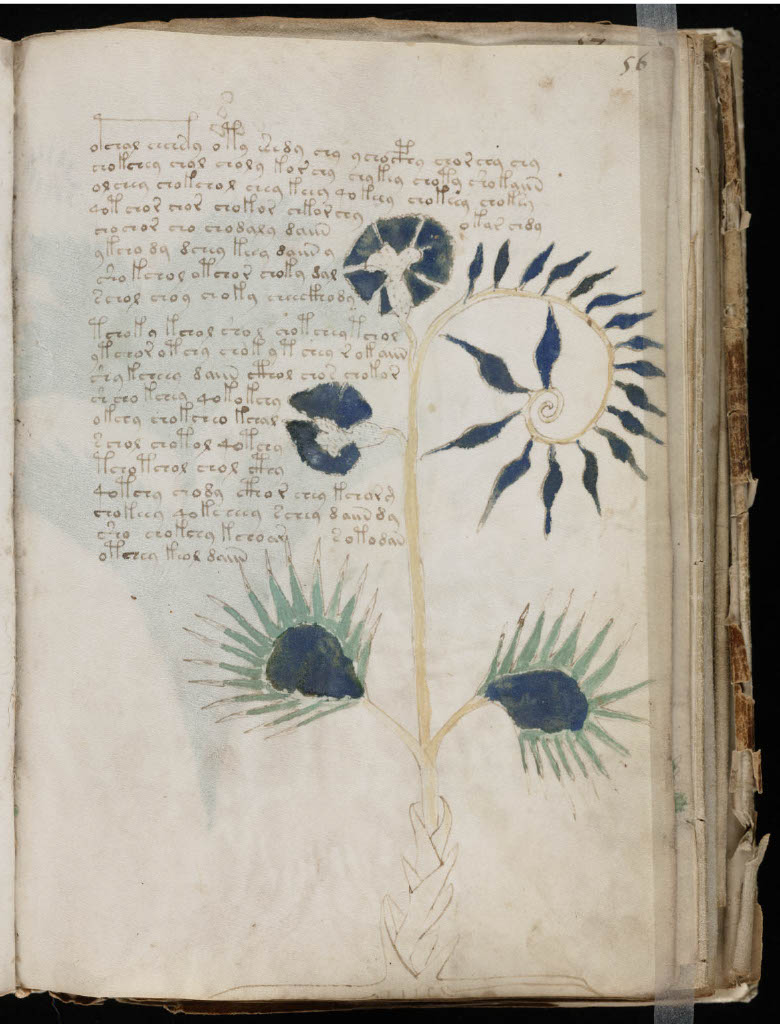
The herbal section is the largest part of the book. It features large drawings of plants, usually with one or two plants per page, surrounded by paragraphs of the mystery text. What makes this section so strange is that almost none of the plants can be identified by modern botanists. They look like strange combinations of different plant parts glued together, with roots that look like animal claws or strange tubes.
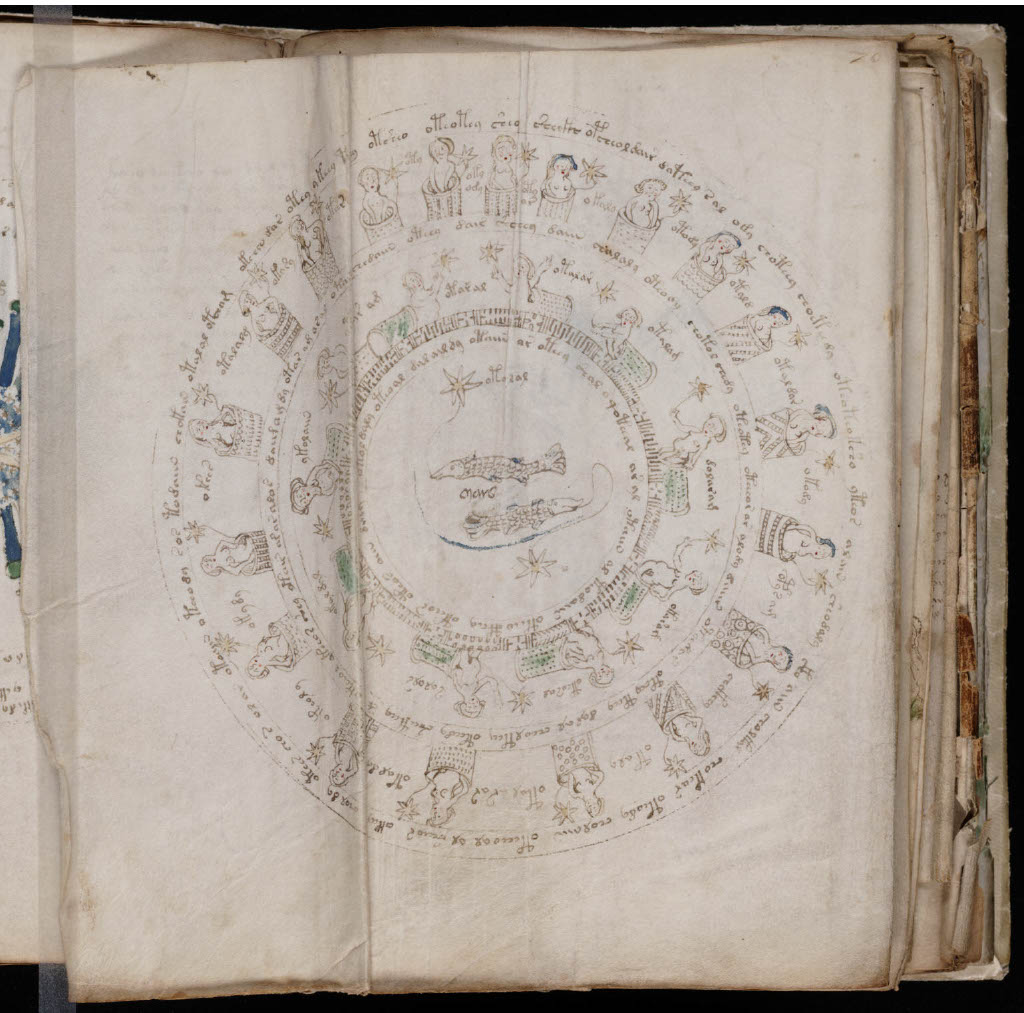
Next is the astronomical section. This part contains beautifully drawn circular diagrams featuring suns, moons, and stars. Some of these pages include recognizable zodiac symbols, like a fish for pisces or a bull for taurus, which are surrounded by tiny drawings of women holding stars. This is one of the few parts of the book that feels connected to normal earth history, even if the text around it remains a total secret.
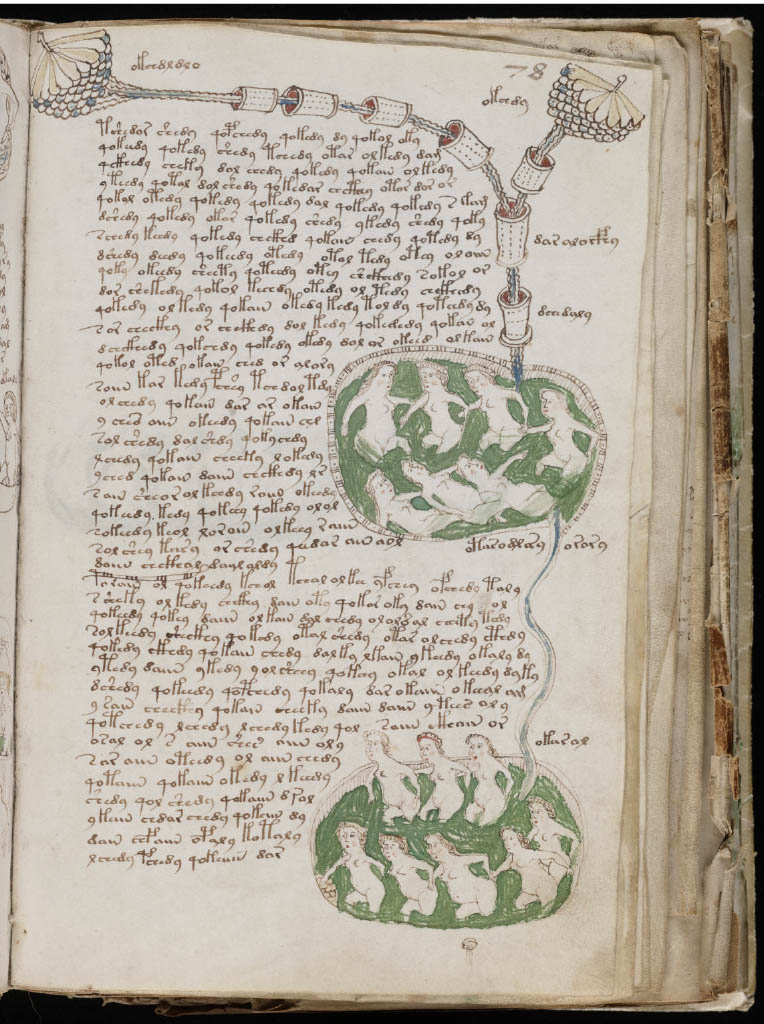
The most famous and bizarre section is the biological or balneological section. Here, the text forms dense blocks that wrap around incredibly detailed drawings of tiny naked women. These women are shown bathing in pools or soaking in green and blue fluids. The pools are connected by a huge network of strange pipes that look almost like human organs or blood vessels. Nobody knows what this represents. Some think it is about medieval medicine, while others suggest it is a metaphor for spiritual alchemy.
There is also a cosmological section featuring huge, complex foldout pages. One foldout is a massive map or diagram spanning six pages, showing nine distinct islands connected by causeways, castles passing through clouds, and what looks like a volcano.
Finally, there are the pharmaceutical and recipe sections. The pharmaceutical pages show row after row of highly decorated medicine jars. Beside these jars are small drawings of plant roots and leaves, looking very much like a medieval pharmacy catalog. The recipe section consists of short paragraphs marked by little flower-like stars, likely instructions on how to use the weird herbs and medicines shown earlier in the book.
A history of mysterious owners
The story of who owned this book is just as fascinating as the book itself. The earliest known owner was an alchemist named Georg Baresch who lived in prague in the 17th century. Baresch was totally confused by his own book, so he copied a few pages and sent them away to a famous scholar in rome named Athanasius Kircher, begging him to translate it. Kircher was famous for claiming he could read ancient egyptian hieroglyphs, though he was mostly wrong about that.
When Baresch died, the book passed to his friend Johannes Marcus Marci. Marci sent the actual book to Kircher in 1665 with a cover letter that is still attached to the manuscript today. In this letter, Marci mentiones a rumor that the book once belonged to Emperor Rudolf II of Germany, who supposedly bought it for a fortune because he believed it was the work of the famous philosopher Roger Bacon.
After arriving in rome, the manuscript sat quietly in a library for over two hundred years. In 1912, the library needed money and sold a collection of their old books to a polish book dealer named Wilfrid Voynich. Voynich spent the rest of his life showing the book to scholars and trying to figure out what it was. After he died, it changed hands again before finally being donated. Today, it sits safely in the Beinecke rare book library at Yale university, where it gives historians a headache on a daily basis.
Attempts to break the code and linguistic analysis
The strange flowing letters of the book are now simply called voynichese. Over the last century, many of the greatest minds in cryptography have tried to crack it. During world war one and world war two, teams of military codebreakers who successfully cracked secret enemy messages turned their attention to the manuscript. They all failed entirely.
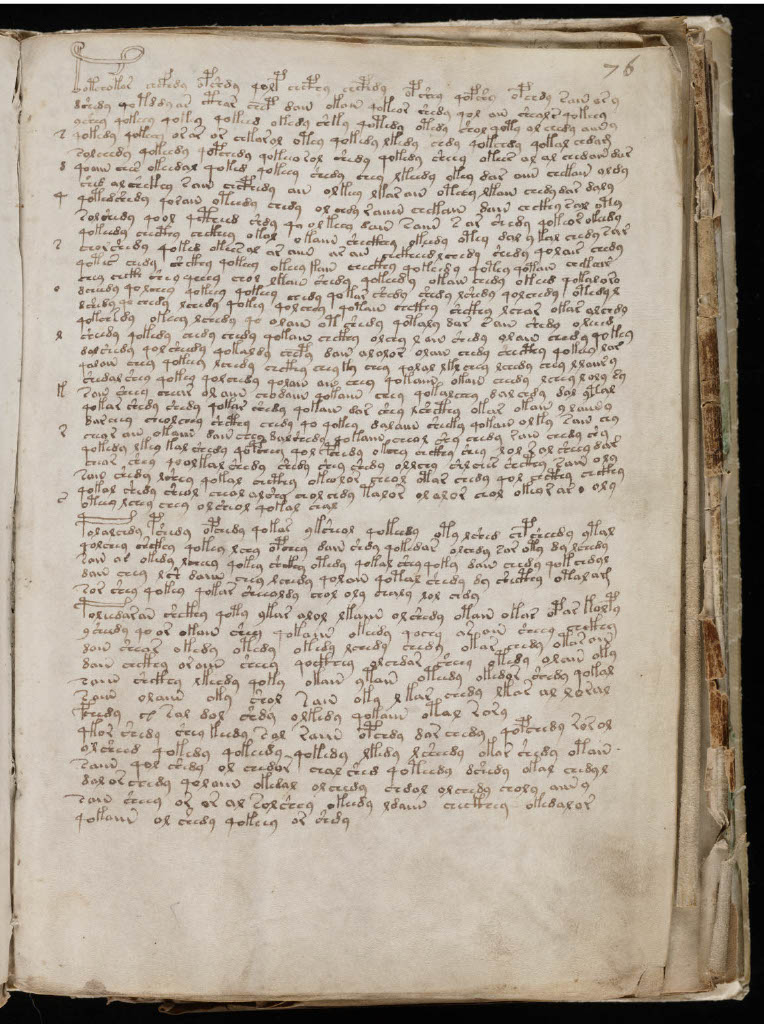
The linguistic analysis of voynichese goes very deep. The text seems to have a small alphabet of around 20 to 30 distinct characters, which is exactly what you would expect from a phonetic alphabet like english or latin. There are almost no massive words and no single-letter words, making the word length distribution very similar to latin. The entropy of the words, which is a mathematical measure of how much information is packed into them, is also incredibly similar to normal natural languages.
However, there are massive differences that confuse every system. There is almost no punctuation anywhere. Paragraphs are rarely broken up by commas or periods. Furthermore, certain letters only ever appear at the beginning of a word, while others only appear at the end. This is very unusual for european languages. In the manuscript, the same word will sometimes appear three times in a row, and words that sound very similar are placed right next to each other. This kind of repetition does not match normal human speech.
The four main theories
Because of these weird linguistic features, there are four main theories about what the book actually is. The most popular theory for a long time was that the book is a complex cipher. This means it hides a real language underneath a secret code. But modern cryptographers point out that if it was a cipher, the word frequencies would look different.
Another theory is that it is a constructed language. Long before modern constructed languages, medieval philosophers tried to invent perfect universal languages. Some researchers suggest the author invented their own phonetic alphabet to write down an obscure spoken dialect.
The third theory argues it is just an unknown natural language. The author might have been documenting their culture’s specific knowledge using an alphabet they invented because their language had never been written down before.
Finally, there is the hoax theory. Because nobody has been able to translate a single sentence, some experts believe the whole thing is just random gibberish. They argue that a clever con artist in the 15th century created a fake magical book to sell to a rich nobleman for a huge profit. However, statistical analysis shows that the text follows zipf’s law. Zipf’s law is a mathematical rule that applies to all natural human languages, where the most common word occurs exactly twice as often as the second most common word. It is incredibly difficult for a human to fake this mathematical pattern by accident. Because the manuscript follows zipf’s law, many linguists believe there is real meaning hidden in the text.
The final conclusion
Even modern artificial intelligence can not translate it, because there is nothing anything related to this absolutely unknown language. AI needs massive amounts of parallel data to learn and compare structures, and here we have exactly zero reference points. It is like trying to guess the rules of a board game without a board and without pieces. But I hope one day we will find some hidden library or at least one more another book, that will help us understand that it was.
But if you want to translate your website into a more traditional language, our website tool is a great in it. You will not need a team of military codebreakers or decades of research to make your online store absolutely multilingual. With just one line of code, you can easily speak to your customers in a language they actually understand.
Make your website multilingual
Break language barriers and connect with audiences worldwide. Expand your reach, grow your business, and go global today.
No credit card required