Every day, people move to new cities and new countries. They need a hairdresser. They need a nail technician. They need someone to do their brows, their lashes, their skin. These are not luxury needs — they are regular, recurring needs. And the moment someone settles into a new country, they start looking for the services they were used to back home.
They open Google. They search. They find your website. They look at it for a few seconds, see a language they don’t fully understand, and close the tab. You just lost a client who might have come back every three weeks for years.
This happens in every city in the world, every single day.
Every city has more foreigners than most salon owners realize
This is not about tourist destinations. This is about regular cities, regular neighborhoods, regular people who relocated for work, for family, for a better life.
Take Dubai. Around 88% of the population are expatriates — people from India, Pakistan, the Philippines, the UK, the US, Egypt, and dozens of other countries. A beauty salon in Dubai with an Arabic or English-only website is invisible to a huge portion of the population who might search in Tagalog, Urdu, or Hindi.
In Switzerland, nearly 26% of the resident population are foreign nationals, according to the Swiss Federal Statistical Office. That is one in four people. In cities like Geneva and Zurich, the percentage is even higher. A salon website that exists only in German or French is missing a significant chunk of the city’s residents.
In Germany, around 13.4 million people — about 16% of the total population — have a migration background that means German is not their first language at home. Cities like Frankfurt, Stuttgart, and Munich have large communities of Turkish, Italian, Polish, and Eastern European residents who are fluent enough to get by in German but would feel far more comfortable booking a beauty appointment in their own language.
In the United Kingdom, London alone has over 300 languages spoken. Approximately 37% of London’s population were born outside the UK, according to the 2021 census. That is a city where walking down one street you might pass a Brazilian blowout salon, a Korean nail bar, and a Moroccan threading studio — and the clients of each of those places might not share a single language.
In the United States, around 46 million people are native Spanish speakers, and over 21% of the US population speak a language other than English at home. Beauty salons in cities like Los Angeles, Miami, Houston, or New York are operating in communities where a Spanish, Portuguese, Korean, or Chinese version of a website would directly reach a massive existing customer base.
In France, particularly in Paris, there are large communities from North Africa, West Africa, Southeast Asia, and Eastern Europe. Roughly 13% of France’s population were born abroad.
In the Netherlands, Amsterdam has one of the most internationally diverse populations in Europe. Around 56% of Amsterdam’s residents have a non-Dutch background — that means the majority of people in that city have family roots somewhere else, and many still feel more comfortable in a different language.
The point is simple: wherever your salon is, there are people nearby who want exactly what you offer and who would book an appointment without hesitation — if only they could read your website.
Where the beauty industry is most popular and growing fastest
The global beauty and personal care market was valued at over $570 billion in 2023, according to Statista, and it continues to grow. But within that number, some countries and regions stand out for how central beauty services are to daily life.
South Korea
South Korea has one of the most developed beauty cultures in the world. Skincare routines with multiple steps, professional facial treatments, semi-permanent makeup, and hair care are not occasional luxuries — they are part of regular life for a very wide portion of the population. The K-beauty influence has also spread globally, which means Korean beauty clients who move abroad bring very specific, high expectations for the services they want. A salon that offers Korean-style skincare treatments and communicates that in Korean will immediately attract this clientele.
Brazil
Brazil has the fourth-largest beauty market in the world by revenue. Hair care in particular is huge — Brazilians spend more per capita on hair products and treatments than almost any other nationality. The Brazilian blowout became a global phenomenon partly because of how seriously Brazilian culture takes hair. Nail care is also a major industry. Brazilian expats — and there are significant communities in the US, UK, Portugal, Italy, and Spain — actively look for salons that understand their hair type and texture, and they trust a salon more when its website speaks Portuguese.
India
India has one of the fastest-growing beauty markets globally, driven by a large young population and increasing disposable income. Bridal beauty services are a particularly significant category — weddings in Indian culture involve elaborate pre-wedding beauty rituals including mehendi, threading, hair styling, and makeup. Indian communities abroad (large in the UK, US, Canada, and Australia) actively seek out salons that offer these specific services. A website in Hindi or another Indian language immediately signals familiarity and trust.
The Middle East
In countries like Saudi Arabia, UAE, Kuwait, and Qatar, beauty spending per capita is among the highest in the world. Women in these markets invest heavily in skincare, hair treatments, and specialized beauty services. At the same time, the expat population in Gulf countries is enormous — so salons in these regions are simultaneously serving both local populations and a massive international workforce.
Russia and Eastern Europe
Despite economic changes in recent years, Russian beauty culture remains intensely focused on appearance and professional grooming. Russian-speaking communities exist in significant numbers across Germany, Israel, the US, and many other countries. These communities often prefer to find service providers who communicate in Russian, especially for something as personal as beauty services where precise communication matters — you don’t want a language misunderstanding when discussing a chemical hair treatment or a specific skincare procedure.
Japan
Japanese beauty standards and beauty services are extremely refined. Eyebrow shaping, scalp treatments, specific hair coloring techniques, and high-precision nail art are areas where Japanese salons and clients have developed a very distinct expertise and expectation. Japanese expats living abroad often find it difficult to get the same level of service, which makes a salon that speaks their language and understands their preferences immediately stand out.
Why foreign clients visit your website and leave without booking
The problem is not that foreign residents don’t want beauty services. They absolutely do. The problem is a specific moment that happens on every website that exists in only one language.
A person arrives on your website. They can see the photos. They can see it’s a salon. They might even recognize a treatment they want. But then they try to read the service list and they get stuck. They don’t know what “balayage” means in your language. They can’t figure out if you do the specific type of threading they’re looking for. They don’t know how to read your booking form. They close the tab.
This is not about whether they speak your language at all. Someone can be conversational in a second language and still feel uncomfortable making a beauty appointment in it. Beauty services are personal. You’re discussing your hair, your skin, your appearance. People want to be precise. They want to describe exactly what they need and be sure the person on the other end understood them correctly. A language barrier — even a small one — makes this feel risky.
And so they keep searching until they find a salon whose website they can fully understand. That salon gets the booking.
Add more images of your actual beauty procedures
Before we talk about translation, there is one thing worth mentioning that works hand in hand with it: images.
A foreign visitor who can’t fully read your website will spend extra time looking at your photos. Images bridge the language gap partially — someone can look at a photo of a balayage result, a nail design, a brow shape, or a facial treatment and understand what you offer without needing to read a word. If your website has few images or low-quality images, that bridge disappears.
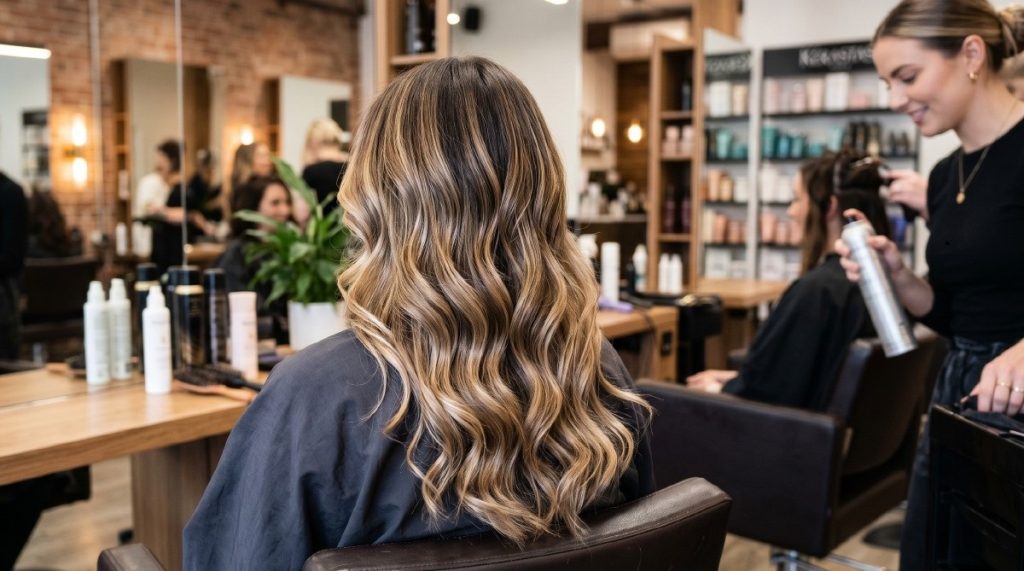
Every beauty procedure you offer should have at least one real photo — ideally your own work, not stock photos. Before-and-after images are particularly effective because they show the transformation clearly and communicate quality in a way that works across any language. A gallery of your nail work, your hair coloring results, your lash extensions, or your skin treatments does as much selling as any written service description.
Good images also make translation more effective. When a visitor reads a service description in their own language and can immediately see a photo of that exact service, the combination builds trust much faster than either one alone.
So before you add translation, go through your website and fill in the gaps. Add photos for every service that doesn’t have one. Make sure the images are clear, well-lit, and representative of your actual work. Then translate the website around those images.
What happens to your bookings when foreign clients can actually read your site
The effect is direct. A person who understands what they’re reading is a person who can make a decision. When the service names, descriptions, prices, and booking instructions are in their language, the friction disappears. They book.
There is also an indirect benefit. A client who finds your salon through a translated website and has a good experience will tell others in their community. Expat communities in most cities are tight-knit. People share recommendations constantly — in WhatsApp groups, in community Facebook groups, at community events. One foreign client who has a great experience and could communicate easily with you in their language can bring several more clients from the same community.
And from a search perspective, a translated website with proper technical SEO setup starts appearing in searches that your English or local-language-only site would never reach. Someone searching for “peluquería cerca de mí” (hairdresser near me) in Spanish will not find your salon if your website only exists in English — even if your salon is two streets away from where they’re standing.
How to translate your beauty salon website without the technical headache
The practical concern most salon owners have is that translation sounds complicated and expensive. It used to be. Hiring a professional translator for every page, then rebuilding the website in a new language, then managing two separate versions — that was a real project that took weeks and cost a lot.
It doesn’t have to work that way anymore.
Translate.jslets you add multilingual support to your salon website by justcopy and paste one line of code. You choose which languages you want — Spanish, Russian, Arabic, Korean, Portuguese, French, or any combination — and the tool handles translation across all your pages automatically. The language switcher appears on your site and visitors can switch to their preferred language immediately.
If your salon website runs on WordPress, there is a published plugin that sets everything up without touching code at all.
The translations can be edited manually, which matters for a beauty salon specifically. Automatic translation handles most things very well, but beauty terminology can be specific — you might want to make sure a particular treatment is translated exactly the way clients in your target community would recognize it. The ability to go in and adjust any translation means you stay in control of how your services are presented.
On the SEO side, the tool automatically handles hreflang tags, translated meta titles, meta descriptions, and canonical tags — so Google understands which language version to show to which users, and your translated pages can actually rank in foreign-language searches.
The clients are already in your city
You don’t need to find new customers in other countries. They are already in your city, in your neighborhood, possibly walking past your salon regularly. They have the same beauty needs as everyone else. They have the money to spend. They are actively searching for salons online.
The only thing stopping them from booking with you is that they open your website and it’s not in their language. Fix that one thing, and a customer base that currently can’t see you becomes one that can.
Make your website multilingual
Break language barriers and connect with audiences worldwide. Expand your reach, grow your business, and go global today.
No credit card required